I have been playing with the Hatch dashboard and analyzing the results from different parameterizations. I noticed in these experiments that the distribution of Impact Hours seems more skewed than I would have expected, and it made me realize that we had likely never questioned the outputs of the data from the praise process.
Although I recognize that people receiving pay from the organization only received 15% of the tokens relative to unpaid contributors, the data seems to suggest that some forms of work in the TEC were more recognized by the praise process than others, and I thought this fact deserved a conversation involving the community.
Looking at the praise data, it seems that a lot of small praises accumulate significantly more tokens than larger tasks with less frequent praise, even if they are quantified relatively much higher. This begs the question: do the results we see land within what we would call a fair or accurate distribution of tokens for work that was put into the efforts of the TEC?
Considering that significant governance in the TEC will be held according to these IH distributions (or funds available via RageQuitting), I believe this poses considerations for community discussion prior to the Hatch.
I don’t mean this as an offense to anyone who received more tokens than anyone else - in fact, I think Rawl’s Veil of Ignorance should be invoked here to some degree, and we separate the desire to maximize for any individual’s best outcome to focus on ensuring outcomes that are fairest to all.
We have established the Praise process to track and quantify contributions, but afaik we haven’t taken a step back to do any quality assurance on whether those processes are outputting signals that we are comfortable with as a community. When using new processes like the praise system to quantify contributions to an ecosystem, we are measuring with Wittgenstein’s Ruler. In other words, we first need to measure the ruler itself to know if it’s good at measuring anything else.
I have put some overall thoughts on improving the praise process into this document, and I believe we should do some preliminary data analysis of the distribution of Impact Hours to learn more, as well as discuss as a community whether there is wider consensus as to whether this is an issue, and how we can address and mitigate it.
A few items to consider in this proposal:
Engage the skills of a few data scientists to understand the distribution of IH tokens more thoroughly & whether there are alternative weightings of the data that feel more accurate to the community
Discuss as a community what a “fair” or “more accurate” distribution of tokens looks & feels like, understanding that this may be fuzzy & vary widely by perspective
If determined necessary, consider various ways to adjust the distribution to be more accurate to how we feel it should be distributed
Create a new mandate for praise-givers - dish widely in the TE ecosystem. We want to get IH & TEC tokens to Token Engineers too! Learn what’s going on and help the system recognize it’s value. Many TEs are too busy doing the work to be present in TEC meetings dishing praise for that work.
I hope these thoughts and recommendations can inspire community conversation around this important topic - comments, disagreement, and further discussion welcome!
Usually in crypto projects this is 5-50% of the total supply that’s distribution is decided by a benevolent dictator (or small group) who, obscurely, gives tokens to an unknown group of people at an unknown ratio’s for unknown work.
In the TEC, we do it differently. We follow a decentralized, Signal Aggregation approach, that is accessible for all to Participate.
Anyone who wants to can praise anyone for anything.
Anyone who wants to can join the praise quantification calls every 2 weeks and participate in the process, after quantification, there is a sense making round to make sure that the results made sense, and it can take into the overall distribution as well. This is how the sausage is made, quantifying Praise into IH.
Anyone who wants to can propose the design for determining the Impact Hour Rate (the rate that IH gets converted to Hatch tokens) right now. The impact hour rate can even be set to be $1 at the Target Goal, and IH could be meaning less.
Anyone who has engaged enough to have CSTK or IH (well over 300 people, and another group of about 200 people that just need to give us their address so we can give them the on-chain power) will be able to vote on how Impact Hours are converted into Hatch Tokens.
#2 Is where there is the measurement of the ruler, this sense making work every week allows us to do a check on the distribution.
There are of course more details here:
Original Intents
While distributing governance rights fairly is part of the intent of impact hours, it is only one of the dimensions that we are using this tool for.
Creating a lovey-dovey gratitude culture and strengthening the relational fabric of our community
Rewarding volunteers for contributions to the creation of this economy
Acknowledging general contributions to the TE Space
Creating a feedback mechanism for work that is valued by community members
Distributing Governance Power to people with skin in the game.
My Thoughts
I think “fairness” in a token distribution is a noble goal but in application it has been very difficult to accomplish both an objective distribution and a distribution that is good for the community.
I don’t think any community can say that their initial distribution was perfect at achieving their goals… Some were absolutely better than other tho. YFI and other defi tokens that had a “fair launch” for instance have had a lot of criticism around this approach.
Vitalik recently discussed this issue in respect to the fairness of Miner rewards. Mining is a very fair process but the requirement of objectiveness leads to an awkward expenditure of capital.
Every individual has a perspective on what fair is. To ETH miners, the mining reward distribution is very fair. To Vitalik… it’s not.
What is really more important than if it is “fair” by any individual’s perspectives (Mining for instance achieves this) is the question of legitimacy.
Is this a legitimate distribution. Here is what Vitalik said:
It is impossible to make a full listing of theories of legitimacy, but we can start with a few:
Legitimacy by brute force: someone convinces everyone that they are powerful enough to impose their will and resisting them will be very hard. This drives most people to submit because each person expects that everyone else will be too scared to resist as well.
Legitimacy by continuity: if something was legitimate at time T, it is by default legitimate at time T+1.
Legitimacy by fairness: something can become legitimate because it satisfies an intuitive notion of fairness. See also: my post on credible neutrality, though note that this is not the only kind of fairness.
Legitimacy by process: if a process is legitimate, the outputs of that process gain legitimacy (eg. laws passed by democracies are sometimes described in this way).
Legitimacy by performance: if the outputs of a process lead to results that satisfy people, then that process can gain legitimacy (eg. successful dictatorships are sometimes described in this way).
Legitimacy by participation: if people participate in choosing an outcome, they are more likely to consider it legitimate. This is similar to fairness, but not quite: it rests on a psychological desire to be consistent with your previous actions.
Obv a lot of these forms of Legitimacy are pretty bad… hahaha but our IH distribution has evolved into a very legitimate practice mostly via participation, process, and continuity.
I’m very excited to improve the process for the TEC post-Hatch and future Commons, but I would be skeptical of changing it too much at this stage as it could threaten the legitimacy of the process.
I definitely like the suggestion that we dish praise widely. It was easier when we were in the TE Discord, but I would love to see more praise given to TE people in general.
Problem: Most top tier token engineers are very busy right now in the bull market & they can only get praise if they join a channel that the praise bot is in, and someone recognizes them for their work…
This barrier of entry is there for good reason. If they are too busy to join the Discord, then they probably aren’t going to participate in the Commons either. Thats ok, the Hatch is just the first phase and they can join later when they can be more free to participate.
Or they buy their way in.
It is important, for our legitimacy, that every participant has hatch tokens because of the skin in they put in the game. The Impact Hour Rate is unknown right now. Most proposals are giving 70-85% of the tokens to the people who put in wxDai. The Impact Hour distribution is only relevant for the 15-30% of Hatch Tokens, and will be further diluted once the we upgrade to a Commons.
Once we launch, the broader TE Community will naturally be more interested in our work and we can always create solutions for improving a poor distribution IF it happens… e.g. a proposal can be made to mint Voting-only governance tokens and airdrop it to thought leaders as needed… or any other outside the box idea to address the issues we run into.
A praise case study was done, and I am hopeful that we can make praise quantification into an app of some sort, ideally tied in with Source Cred, and we can make a lot of important improvements for the next iterations of this tool.
I hope that we don’t do anything to challenge the legitimacy of the distribution by manipulating the results outside of the normal process. Dish praise to people and then we quantify, the final impact hour rounds are yet to be done.
I’ve been on the community since september, i probably join almost all the events at TEC held since then. And in my honest opinion the distribution of impact hours before removing the IH to the people who is getting paid it’s precius how accurate it looks.
In my opinion, we need to look TEC as it’s own thing its not CS neither 1hive or Giveth, I could see post hatch TEC doing an airdrop to them. I honestly don’t know how CS or Giveth work, but in the case of 1hive, 1hive are all the token holders. And the snapshot could be taken right after the second proposal asking funds, but thats a decision that TEC have to make.
Regarding the small task vs big task i saw this issue pretty long time ago and the problem i was seeing its people who do alot of small tasks like myself was getting in my opinion overpaid when doing praise quant that’s one of the reason i stopped going on the praise quant, it feels very bad getting +1ih for doing a retweet.
That being said, everyone involved enough with the TEC knew about that and right now isn’t the moment to change any rule, we are here how we are because the decision we take as a community just before launching the hatch is not the moment to make any big decision with the risk of breaking the social contract we all made.
I consider myself a builder and I really care about TEC and im super curius abut to see what people do, thats a social experiment after all. But the people who put time in. In my opinion it’s more likely to care about the decisions being made, puting money its just a couple of clicks (its not a bad thing) thats why if somone listen to me the lasts days on the params party’s im always very cautious with the CSTK ratio, but at the end of the day i trust the process and people who have CSTK are cool people that we want in or atleast that’s what i say to myself 😛
Looking for fairness, it’s an awesome value, but legitimacy, its way more important in my point of view and that’s something that also came up when we started to rotate the praise quantifiers. Someone said about giving IH back to Griff and Livi because of the hard work they did previously, but we didn’t create IH to them from no where that would go against the legitimacy of the project on a very early stage.
In my opinion, there is no ruler, there is a protocol and everyone in knowing about it. That being said the spread sheet could be more transparent and usable. There were many times I wanted to check it, but didn’t do it because there are many tabs hide and I was fearing messing it up (I really trust the data myself but its important for mutual monitoring).
The good thing it is not the last common we learn from here, I would not break neither the social contract or the protocol. In the worse case scenario we don’t reach our MIN goal and IH are gone and that would be ok its respecting the protocol (that’s why IH have a social value not only economic, people getting paid lose less, that’s very personal but I don’t like this mechanic of people being paid I know it have pros and cons not going to debate it here)
That’s why, if the project its good enough they will put money in and govern it (Let’s be honest the price to get in isn’t that high, we are talking about TE’s after all)
I think that’s an interesting discussion we can learn a lot of things. I’ve not been involved with the community outside the swarm as much as I would have liked to (coding requires focus 😅), and I don’t have a big comprehension of what could go wrong with acknowledging contributions. I will give my opinion on what we could do and what we shouldn’t do to improve the system and the valuations.
We have knew since the beginning that the system was not accurate at all, that it is mainly subjective, and “nobody wants to know how sausages are made” as we used to say referring to the process of converting qualitative praise data into quantitative impact hour numbers, but I think something not accurate doesn’t mean that it is not fair.
I consider a system to be fair when its rules are clear, everybody plays with the same rules, and we can verify openly that processes are being followed as it was expected. Even if the final outcome is not the most desirable, it is fair if the process has been open to everyone and have given partial results that people could react to (by changing their own behavior, by introducing changes to the system, or by challenging it). This process has created legitimacy, or as zepti was saying, it has forged a social contract that is not desirable to break.
Acknowledging people we may failed to acknowledge these last days before the hatch could be a good way to go. Although, I would not “print” more impact hours above the natural tendency we already had. We don’t want to be like FED printing trillions in just one year 😜:
That being said, I think @JeffEmmett suggestions on how to improve the praise system are lit! Understanding the praise data using data science could be really insightful to find its weak points, such as little vs big contributions. And the praise quantification should probably be done easy to do if we want it to be transposed to other daos.
Thank you, @JeffEmmett, for raising this issue and to @sem, @Griff and @ZeptimusQ for responding here. I am still processing these ideas and immediately appreciate three things:
the raising of the issue itself,
the importance of maintaining legitimacy/the social contract,
Jeff’s great ideas for improving the process.
I know there is a lot more to say and share, but I just wanted to throw in my two tokens (did you see what I did there? ;)) and be part of the process! 😃
My questions in a dialectic process are always: How can we transform this into the most desired situation?, and what would be the best possible outcome?
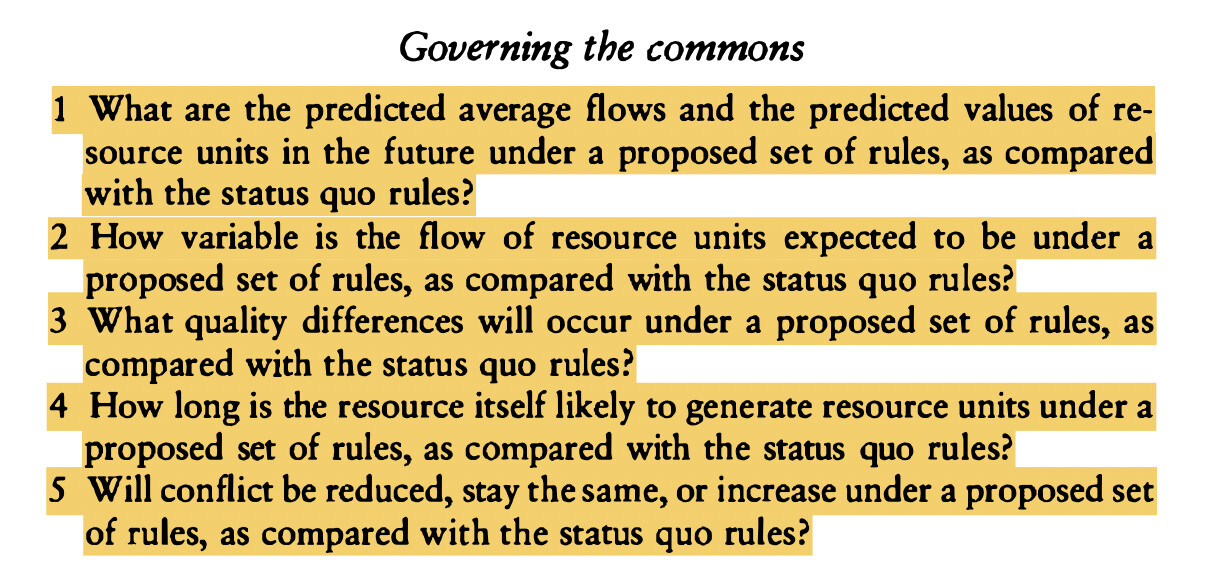
Using Ostroms framework for institutional change, and seeing the TEC as a conflict transformational platform we could ask ourselves for the ex ante and the ex post costs of a proposed change and try to use a credibly neutral criteria to guide our action.
“If the expected costs of transforming the rules are higher than the net benefits to be gained, no further cost calculations will be made. Appropriators will retain their status quo rules that produce fewer benefits than would alternative rules, because the costs of changing the rules are higher than the benefits to he obtained. If the ex ante costs of transforming the rules are not too high, expected changes in ex post costs will also be evaluated, including the effects of proposed rules on monitor ing and enforcement costs.” Governing the commons, p 198
We don’t want to loose any of the legitimacy we have built from the process as its been done so far, and instead we want to gain more legitimacy from the sense making and feedback. So let’s have an open and safe conversation around this.
Personally i don’t have problems adding an extra filter to the actual IH distribution process, but i would only want the filter to have an overall better legitimacy and feeling than the one we have.
The other day i said this was like cooking, we are making an exotic dish, mixing a lot of ingredients and maybe we now that we try the flavor, it needs some balance before putting it in the plate.
I say this as someone who wouldn’t be here if it wasn’t for the work of some Token Engineering pioneers (that can be higher in the table), but also for the loving culture that derives from !praise allowing community building around contributions, thankfulness and recognition 😃
My thinking is that all contributions are valuable. And that we should try to promote the best feelings around the commons that will be born for it to start with right foot!
🧐 Let’s open up this Praise System algorithm and see what’s inside!⚗️
I am happy to see this thoughtful and diverse mix of opinions here in critically thinking about the design of our systems and processes, and in analyzing the governance decisions that have led us here, and being open to that being an evolutionary process worthy of time, space and lively discussion and debate.
Thank you Jeff, for raising critical questions about the systems we are engaging in, and Griff, Zepti, Sem, Suga, Juan, for your thoughtful consideration and all of your responses.
The Praise System
No decision is static and these processes are all as we create them together - and they are experiments. These systems have not been tested and validated - but we now have an opportunity to do so. To use Token Engineering to validate our designs! (or at least analyze them)
Because it is in an Excel spreadsheet with formulas, does not make the praise system an objective system that accurately reflects the desired distribution of impact hours and governance that the community wishes to see. Nor is it legitimate, simply because it is a process. The Praise Case study was NOT a QA testing or objective analysis using data science.
We manipulate the system inside the system - so does it matter if we “manipulate” the system inside or out - whether we adjust the scores arbitrarily inside subjectively and without context to the outputs to “pump” scores or use algorithmic adjustments / weighting on the outside - only with data analysis, it’s actually scientific and has context. (Ironically and namely we manipulate the system inside, to raise the score of Token Engineers because we want them to participate and have more governance!)
With data, we can examine the system as a whole, see if it meets the needs and desires of the community, and use algorithmic adjustments to tweak the system. Legitimacy is just perception. What is more legitimate - manipulating data blindly or applying a data science approach to explore the system?
Raw praise input in the parameter configuration dashboard and voting on those parameters to adjust the IH rate will not suffice - we need to consider adjusting the distribution, not just the IH rate - Computer-Aided Praise, like we have Computer-Aided Governance. It does not mean we HAVE to act, but we should explore.
This is straight out of the book “Ethical Algorithms” by Michael Kearns and Aaron Roth - paraphrasing: we should never initialize complex systems with raw data from untested algorithms.
We can’t just say the praise system is legitimate because it’s a system. Nation states run by dictators think their systems are legitimate too. A social contract by definition is “legitimacy of the state over the individual.” Are these the things we want to cite? Do we want the tyranny of the process and our attachment to the process to overrule the ability to consciously respond to the present moment, when we have new information?
The Decision Space & Origins of the Praise System
We made the majority of the decisions and two votes - one last August and one last December - on the Praise system with no data, or knowledge of the process outcomes.
This is part of the problem with our current systems. In the US, we vote every four years for most things. We have so much better signal processing now! We can update our decision making with real-time data!!!
The reason this is surfacing now, is that we have data, and are able to see the effects of the system as an input to the dashboard. NOW, we have data we can use and potentially apply. We can ask ourselves and our community, was this what we collectively wished to see?Should we apply an action or modify the rules?
On an “open process” & democracy
Just because votes were held, does not mean that the system is democratic. Open democracy in civic settings also has communication/notification requirements for major votes, and allows for time to petition. The overhead of participation and attention cost in this community is very high, and is a barrier to open access for voting and petitioning with the burden on the commoner to keep up or stand aside.
Ostrom’s principle #3:Ensure that those affected by the rules can participate in modifying the rules. This is our chance to enact Ostrom’s principle #3. And have a discussion as a community, about modifying the rules.
Let us look at the present moment, the new information and knowledge we have and respond consciously, rather than reacting to a challenge to the status quo and entrenched system.
This is an opportunity to pause, and act consciously before we ask our community to invest thousands of dollars, and assign majority governance over our economy.
To me this is less about token distribution and “fairness” and more about democracy, governance and self evaluation, and the fact that the actions we take here will have a huge ripple affects, as we are at the seed level in creating these templates and blueprints that other communities are looking to. That is why the choice we make now is important! This community is amazing! And has done fantastic work in building governance frameworks.
It not personal, or about feelings or token allocation, it’s about data and advancing Token Engineering. We don’t need to stop, we don’t have to act, we just need to think 🤔 and exercise our democratic muscles as a community 💪
I propose that we do basic data analysis with data scientists, and hold a presentation of the findings in a well advertised (at least three days advanced notice) community hall discussion with the wider community.
It’s actually quite simple. All it takes is a few hours of discussion and analysis, and if we decide that the costs to change the rules are higher than the costs of the status quo - as Juan so wonderfully suggested - then we forge on. But at least we will have gotten feedback from Token Engineers (the community we say we are building for), made a choice consciously now to employ a system that we know is flawed having looked at the data and applying a scientific approach, and we will have allowed for true democracy to flourish.
Discussing token distributions and payments is really hard and rarely is done publicly (outside of communities with sourcecred :-D)
Money is a really weird thing, and it has a tendency to be challenging in relationships and I’m really proud of how openly we can talk about all this distribution.
I’m here again 😃 I don’t believe it myself this is fun and addictive (the politic side). Pls if something sounds rude or very straight forward its not my intention, my main goal its to share my thoughts and keep learning from you guys. For me, it’s very important, we stick together.
It would be awesome to apply data science and see the results, I honestly think they wouldn’t be much different tho (if we don’t modify the data). Humans are really good at using the eye to get the result. For example, a group of friends go to dinner together and at the time of payment we distribute it equally. Then a member complains that I have consumed less. In two minutes the accounts come out, this person has consumed more and add 10 euros and these two who consumed less pay 5 euros less each. It’s not 100% accurate but it’s very accurate and the cost of doing it 100% accurate takes more effort.
With this little exemple i’m not trying to say we don’t have to be accurate in the future. But the results it self should be pretty accurate. Do a new distribution at the last minute might not be the best thing. How will contributors act after a change? I think this would create more conflict than solution even if the change is little. I’m really against changing past decisions. We are on blockchain after all.
Another argument I have against it’s really not the moment, it’s go time. We had plenty of time before to check and update our rules. Specially on december i was really not happy how we approach praise (at that moment i wasn’t good enough to write like i’m doing now so thanks you so much TEC 💛, still plenty of room to grow and that excites me)
I really agree with sem (i would change fair for legit) but would be nice more engagement from the community, specially stewards
Yeah that’s so true it’s not something I personally agree with. If someone wants to join our common and contribute to advance TE field , anyone is welcome specially TEs. That being said I would love to hear what would be the redistribution we are talking about and how that would benefit TEC.
I’m so sorry about the misunderstanding, I was not referring to what Jean-Jacques Rousseau wrote in 1762 there is no state here. What I really mean when using social contract it’s that there are rules, boundaries and agreements in TEC that we shouldn’t break for the well-being of the common. TEC cares about the individuals (TEC needs them) but the main goal it’s advancint TE. That’s how I see it. In the long run having a TE public goods will help the individuals.
The onboarding document (i can’t find the english version) was talking about IH around 20-200. The human eye :p. Every blog post that happened every 2 weeks I was understanding that all these people were adding this money to the hatch (20-200$) in the case we succeed.
That’s why talking about redistribution makes me untrust the process.
I honestly agree with you here, I’m not sure how well the process will end. It was very open and it’s scary to see the future but also exciting. I feel like trusting our governance culture but that’s my personal feeling.
Democratic doesn’t mean it’s good, Hitler took power via democracy. I really love the blockchain space culture “skin in the game”.
One thing it’s modify the rules for a better being of the community looking to the future with the consensus of this one. But if I don’t understand it wrong, what it’s being suggested here is to change the actual distribution which means change the past and remove value from some individuals to add it to another. How are we going to handle that?.
That being said, TEC should care more for the TE field than for individuals. If there is a strong argument that would benefit the TE field in the long run we should consider it, so please share. And if yes, does it need to be done asap? why?
I really think that what you are suggesting must be done. It adds value to the TE field 100%. But I’m personally really concerned with the topics mentioned above.
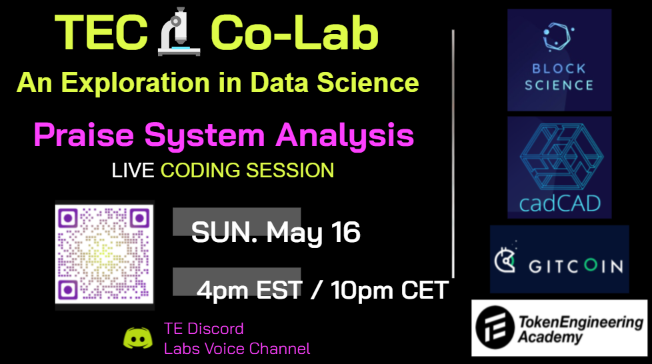
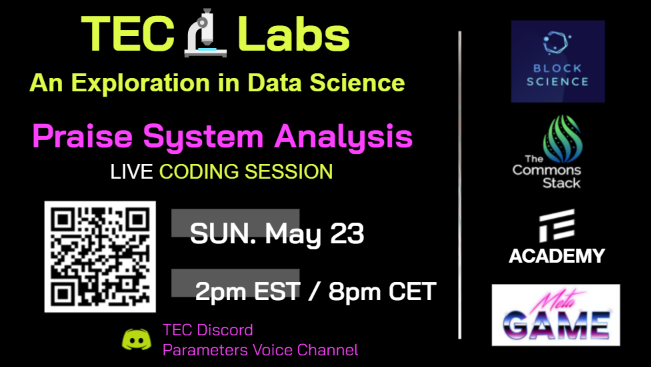
NEW TIME: The data science session will begin at 4pm EST / 10pm CET - Apologize for any inconvenience, and if you cannot attend, we will have a follow up session scheduled farther in advance 🙏 Look forward to seeing you there!
🙏 A huge THANK YOU to the community for engaging in the kick off meeting to research and analyze the Praise System!
We will be holding a focused data science session this week to employ the help of our subject matter experts in analyzing the data and posting follow ups as things progress.
In the meantime, see below and look forward to sharing updates as the work progresses:
Here is the Hack MD where we sketched all of the ideas for what data slices to look at
We are working with Angela Kreitenweis, founder of TE Community & Academy. She called this an “admirable action” and feels deep respect for the community to be willing to question these systems and processes, and is excited to join the community on this token engineering initiative and a wonderful educational opportunity. She gives her full support and is working very hard to coordinate with data scientists for a live coding session to begin digging into this work as soon as possible.
We are putting together a hack session with a group (3-5 + data science Masters/PhD students) of the top data scientists in TE community next Tuesday and ahead of that, will have a focused working session in TEC Labs on Sunday (TBA).
Will post here and on Twitter events as they are scheduled.
Thank you so much for coordinating this effort Jess, let us know if any session will happen today, mainly I want to learn and just watch during this sessions, and help however is possible.
Hey Jess, you are telling TE they will have more IH tokens? They will feel disappointed when that doesn’t happen. Our reputation will decrease. Even if TE don’t have as much governance of the commons, they still will receive funding pool funds for their work and if they decide they can buy TEC tokens as well
Could you tell me what do you think about my arguments in the previous post, pls?
Data will tell you whatever you ask for it. Will data tell you all those IH whales (not whales of the common which look like its not being understood) had to sell their crypto on a bull market to be here full time?
Hi Zepti, I am not sure where you got that impression, I am not telling TE anything about tokens. I am asking for data scientist to review different parts of the data, based on suggestions submitted by the community in the meeting last Sunday, and in the Soft Gov meeting yesterday.
I don’t want to engage in debate or convince anyone as I am not advocating for any particular action, except to have a deeper look at the data, based on the suggestions by the community.
The data scientists that we are asking have no stake in this system. Only Shawn, Sem and Andrew Shinichi (who may or may not participate in the analysis) have any stake or Impact Hours. The others, who will be doing the majority of the work, are impartial and have no Impact Hours, and will not be affected by any decisions made by the community or the outcome.
The main look - at distribution, is not a subjective matter and has percentages that exist as fact. Anyone is welcome to submit suggestions for what aspects we should look at, and the sessions will be open, pre-advertised and recorded.
I worked on this yesterday with a student, forking ygg_anderson’s GitHub repo and adding our own file praise_to_and_from.ipynb. Here is our repo:
We did some preliminary analysis on user statistics, including trying to clean the data set by standardizing usernames (we have consolidated variations on Discord usernames due to typos, etc. but still need to cross-reference Discord vs. Telegram) and dates (addressing the fact that some are in EU format, others are in US). We plan to keep working on it before Sunday’s meeting. Forks, questions, suggestions, information welcome.
My main question at the moment is:
What are the variables “v1”, “v1max”, “v2”, etc. ?
Thanks for the chance for me and my students to be involved in this!
🙏 Thank you@octopus !!! So amazing this could be a learning opportunity for your students (I put a shout out to MetaGame here on our graphics as well 😃 )
🧪 There will be a focused work session this Sunday to do more work on the data. Due to the limited availability of guest data scientists and our wish to expedite the process, discussion will be limited to the work around the data only.
🌈Everyone is welcome to join, and input is welcome here on the forum for any ideas that are not already included in the HackMD, in regards to analysis.
🌱 The Soft Gov Working Group will be hosting continuing discussion for any other related topics. Thank you for understanding and look forward to watching the live coding and data analysis coordination session! 🙏
We have consolidated variations on Discord usernames due to typos, etc. but still need to cross-reference Discord vs. Telegram
We have the data in the praise sheet set so that every user has one canonical username in the first column. The data we use for this is in the “DO NOT TOUCH” tab 😃 This wasn’t perfect, some duplicates made it thru originally so some corrections have been made in the results tabs of the original spreadsheet but these are easy to capture for the most part… I hope 😃
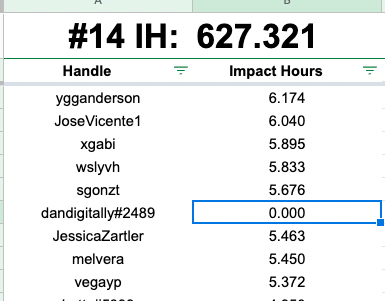
like this one… ddan changed his name a couple times… 😃 but all his other names should have been 0’d out.
If you have any other questions about the data, I encourage you to reach out to me and i should be able to answer every question and give advice on how to most effectively process it, I’m sure i can save you a lot of time.
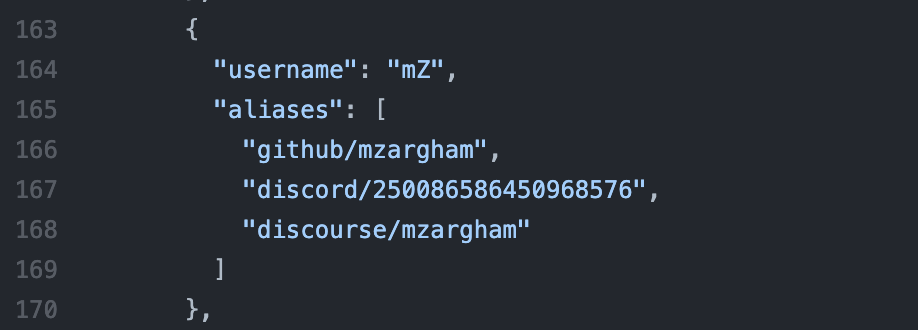
With regard to merging data back into a 1 person 1 record data structure despite the use of multiple platforms, we might want to consider something like MetaGame’s project.json.
It contains json which allows one to define identity merge across multiple platforms. One thing i particularly like about the setup in metagame was that the user themselves provides the identity merge info via a bot in discord.
It may not be the right solution for us right now, but I’d like to flag this as something we can improve upon in the future.
I think it can wait for now; we already have strong uniqueness from the commons stack trusted seed which gives us ETH/xDAI addresses mapped to real life humans! However, those humans end up fractured across their respective points of interaction. Implementing a discord bot that allows those people to bind those IDs back together by updating something like project.json could help reduce complexity in data analysis and make the results of the praise process and things like it more transparent.
Very interesting…! I’m still debating(with myself) on what schema the data should follow, with regard to being break-proof and being easy to query, for the sourcecred bot
Thanks for pinging me! 🙂
I’ve been wondering over true unique keys with which to query the data.
Initially, I settled on discord-id, but reading this, I realise that this might fail in cases of people changing their discord account.
The current storage form is-
users: Collection([
  {
    _id: uniqueObjectId from mongo,
    id: <discord-id>,
    username: <discord-name>#<discord-discriminator-tag>
    github_username: <github-uname>,
    forum_username: <forum-uname>,
    wallet_address: <ETH-address>
  },
  {
   ... same fields as above for different users
  }
])
There is an apparent lack of schema here, so that the user can be directly queried via any of the fields(I have to write some pre-data entry logic to ensure that they’re unique). But, I think canonical names would indeed make really good points of consideration, since the Praise distribution uses that. I think I should maybe add an extra field, or maybe adopt a version of the Metagame format.
(The only issue with keeping a list of aliases is that it’s not a direct key(not directly queryable from the API, thus needing to load up all of the data, which might get slow), and hence it’s going to identify users using just with their github/discord. *harder, but totally doable).
The reason for keeping _id is to ensure that there is always one context key that doesn’t change and is permanent. (even the canonical names can change, given time). I agree that the ETH addresses from Trusted seed application are the most valid data with respect to verifying humans. However, in future cases, I think these could also be changed(wallet keys lost or some similar situation from a user)
This data is in JSON(stored on Mongo, and thus directly query-able). Moreover this format could easily be turned to a single SQL table/spreadsheet/CSV files for data analysis
I’ve updated with what I was able to do in terms of cleaning/standardizing the data we already have:
standardizing dates (year first vs. year last)
making room where praise was dished easier to see
giving each user their standard name from the “DO NOT TOUCH” list, plus trying to catch case issues. As best I could, each praise instance now maps to a standard ID that matches their CSTK ID if possible.
Thank you everyone for a great session today everyone!!! With a special thanks to @octopus@ygg_anderson for leading the heavy lifting on getting the data work going. Here is the HackMD with the research questions and notes so far:
We will be scheduling a session for Tuesday focusing on categorizing the praise. Will post soon 🙏
You are all warmly invited to a hack session tomorrow at 12pm EST / 6pm CET on the TEC Discord - Parameters Voice channel focused on creating Praise “categories” to look at the distribution through that lens - look forward to seeing you there! 🙏
There is a lot of incredible materials to read here!
One question regarding praise and work on TE: are you considering hours by contributors on the TE Community repos that have been working in paralel of TEC and unaware of the praise system, but that are valuable to TE Academy / Community?
In our case, I’m talking about Balancer Simulations. Here for example there was a lot of work by Angela and Vasily that is nor reflected in commits and we didn’t measure by praise.
Is Token Engineering Community separate from the Commons?
A quick update: we had a very productive session yesterday to start the work on categorizing contributions. You can see the work here Praise Categories - Google Tabellen and feel free to add comments or input using the comment function in the doc or replying here. Also, here is the handy link to the full notes/work/Github links in this HackMD we are using.
Our next work session is Sunday - we could really use help then to do some praise grouping - which is heavily manual, and would be quicker with help 😃
Warmly invite you to join and support this work which will be an important next step in getting this analysis completed 🙏
@Raul For sure! Yes, that is part of the work and what we are looking at, is how we have valued, not valued, “overvalued” or “undervalued” various contributions - and more so, the general distribution %s. This is reflected in this category sheet but if you had any other comments, or would like to participate in this work, we would be super lucky to have you! I know you are busy as well, so if not and just want to add more thoughts a-sync we welcome your thoughts and input 🙏 Also opportunity on the modeling/data science side to jump in if you would be interested in the work any time is appreciated.
Other projects have shown interest in using the Praise System, so this work goes beyond just this instance, as we look at reward system patterns. Thanks so much for commenting on this thread - so nice to hear from you!
Oh and about TE Community and relationship to TEC - the TE community is a HUGE part of the Token Engineering Commons, but they are “separate” as “organizations.” The idea for TEC came out of the TE community, and is meant to create an economy to advance the field of Token Engineering. So in the initialization of the TEC, we are looking at balancing rewarding those who supported the build of the TEC, and those who are contributing to the field - it is still very much up for discussion and the reason why we are digging into the rewards system analysis - to see if the system/algorithm achieved the goals of the community - so your voice and input is very important as well in this discussion, as it would be great to hear from the wider community, and have participation in this discussion and any votes we hold to make decisions on this topic. 🙏
If you are interested in attending a Zoom meeting at 9 AM EST (noon GMT/3 PM CET) where I will go over some of our progress on Praise, please meet me here:
More information:
andrew octopus is inviting you to a scheduled Zoom meeting.
Topic: andrew octopus’ Zoom Meeting
Time: Jun 11, 2021 09:00 AM Eastern Time (US and Canada)
Looking forward to discussing this more. I know some other data people have ideas and progress to share, too.
Edit - Update: Using the invaluable discussion from yesterday (video in previous post), l made some progress on analyzing retweet Impact Hour data.
It’s not hard to identify the retweets, since “retweeting” was consistently used.
Problem: it is a bit hard to get the IH per retweet, since these values were sometimes hand-edited by the quantifiers if they felt the total IH for an individual was underestimated based on their initial calculations.
Assumption: We are going to assume that for a given period, all retweets were worth the same amount, which was given by the mode (most common IH value) of the retweet praises.
For instance, in period 7:
there were 17 praises for retweeting
15 of these got the same value: approximately 0.26 Impact Hours
-one retweet praise got 1.98 IH
-one retweet praise got 4.24 IH
I would then assume that the values 1.98 and 4.24 are edits, replacing them with 0.26. For data purposes, this just becomes 17 values of 0.26 IH.
I am making this assumption throughout: that the mode IH value of retweets for a given period represents the “real” value, and any deviations from that are hand edits that can be replaced.
This makes the analysis a lot easier, so we can make some basic statements like:
for periods 7-17, retweets were about 12% of all praises during this time.
for periods 7-17, retweets accounted for about 3.5% of all Impact Hours awarded during this time.
We can do a breakdown period-by-period and provide some graphs, but I wanted to go ahead and provide the answer to this question since it had been repeatedly raised in meetings.
We discussed a few possible approaches for proposals moving forward with the analysis in soft gov today. It was a discussion call where everyone present was able to share their opinions. I think is worth sharing some of the sentiments here, specially the 2 most polarized ones:
The analysis is great for implementing future changes that won’t affect the already quantified praise and Impact Hour set. The distribution we have now is seen as the results of agreements and expectations that shouldn’t be changed retroactively in favor of the trust built in the community so far.
The analysis could possibly change the IH set we have so far via proposal making because it is offering relevant information that we didn’t have before. The distribution we have now is seen as skewed and unfair because agreements and expectations were stablished without enough insights of their consequences.
I think this is the first debate we should have that will greatly affect how we move forward with the process and what is the scope of the proposals we will have.
I’ll tag a few people for advice process here. 🙏
Thank you @liviade for this update and advice process.
In the Stewards call now, @ygg_anderson is looking to create a summary of the Praise System analysis, and initial suggestions for a possible intervention.
I feel we should schedule a discussion with a more diverse and larger group of stakeholders who will be affected by this decision and would like to have a voice and input in this process, especially those who could not attend this last meeting. I propose we advertise this discussion/agenda at least three days in advance - to hear more points of view and together, discuss possible proposals going forward, and a process by which we decide on those proposals.
I propose we hold this session next week during the regularly scheduled Soft Gov meeting next Tuesday, June 22 OR, maybe a time that is more friendly to those in Europe/CET?..
I also would like to say that trust building is an ongoing process, and this is a huge part of it. When we realize that our systems aren’t serving part of our community, and that part of the community is asking to be heard, how we respond is part of building trust as well.
The agreements that were made, were made several months ago (August 2020 / December 2020) with only a total of <10 votes. Should a community of hundreds have to abide by 10 people’s decision six months ago? Or should we now re-assess, hold a vote, and hear more voices with the information we have now?
These are questions to consider - so, I think meeting with a larger group, hearing everyone’s voices once again, and then put it to a vote. We could vote on whether or not to have an intervention first, and if the community decides to intervene - do a similar process to the Hatch Configuration process - we could do with or without the forking depending on time constraints for the hatch - let’s discuss the decision space and process, would love to hear everyone’s ideas.
Thanks for replying to this! It’s super important to have multiple stakeholders opinions, specially the ones that have been most involved in this discussion.
I would love us to use advice process more often so we can have well articulated written points to help with sense making. - Sounds great to host another session to hear everyone during next soft gov meeting. What about we start adding the emails to the existing calendar invite now?
I had similar thoughts about the decision making process. @Tamara also suggested we can add the non intervention as a proposal to come together with all the other proposals for intervention. I think that’s a good approach if we debate them openly.
After coming to the session with @octopus chatting with @ygg_anderson@Griff and listening to the lab calls with everyone I suggest this 3 possible categories for proposals
Paid contributors deduction
Restitute x% of governance power through infinite vesting
Could the vesting be broken in the future?
Could vested tokens be burned?
What are the implications of programming the bonding curve for the governance tokens?
Restitute an x% of governance power and compensation
Categories
What categories are under or over represented?
Implement a distribution similar to SourceCred? Eg. percentages of total IH go to different buckets.
UBI/Gini Coefficient
Decide the amount inside a range of 5 to 25IH to be distributed
Distribution would happen in a bell curve to the middle.
How do we decide the middle?
I initially thought Tokenlog would be the best tool for this, but I’m starting to lean towards lots of debate + 1 person 1 vote to have a better representation of people’s opinions. I would love to discuss this more as well.
Thanks @liviade for these ideas… I think it would be great to use our TEC email list to advertise the discussion to all IH holders to come and participate via newsletter - perhaps @chuygarcia92 would be willing to work on this? Or at least make a Tweet with the invite link about it with enough advance notice to participate (at least on Friday/Monday), and if we hold a vote, to advertise via email in a newsletter.
There was also a suggestion to look at additional TE notable contributions that came up, or potentially offering everyone a # of impact hours to “gift” to someone other than themselves for work they feel wasn’t recognized. Also want to keep it as simple as possible…
And just one comment about voting and intervene vs. no intervention - If we put up a vote with one no intervention proposal, and three intervention proposals, this would split the vote and not really be a clear indicator - unless we were to total the votes for the three intervention proposals, and weight that against the non-intervention proposal - something to discuss and think about… thank you!
More diverse and wider-community POVs are highly desirable. As Stewards, we serve the community. Even the community that is not highly visible, or present, in our daily calls. Though how much wider-community participation we can expect is a question. It takes time and commitment to understand the origin, process, strengths and flaws of Praise and Praise Quantification, of TEC Impact Hours and what we mean by the “builders” distribution, of the unique circumstances of the people involved, and then, after grokking all this, having the confidence to make a decision that may affect other people’s lives in ways they are not sure they can imagine or affect the TEC in ways they cannot be certain of. I am sympathetic to the challenges present here. Yet I still think that more should be heard and their perspectives sincerely considered.
On the subject of the decision space, this is not an area I have any expertise. Looking at this rationally, here is my thinking:
On having an initial yes/no vote on whether to have an intervention or not:
If the interventions are not first defined, then the alternatives to a no-intervention are unknown. Effectively, a yes-intervention vote would commit one to an intervention without knowing the specifics of the interventions to be proposal.
If the interventions are first defined, then the alternative choices to no-intervention are known at the time of the vote.
On having a vote for all proposals, one being no-intervention, at the same time:
I concede the point, @JessicaZartler, that the yes-intervention vote will be split in this case.
The idea of totalling the yes votes presents some problems as I see it. Rather than splitting the vote, it introduces a multiplier. I wonder how that can that be resolved.
One possibility is having only one proposal for yes-intervention and one for no-intervention.
Another possibility is a runoff of the top two voted proposals no matter what they are.
On 1-person 1-vote versus token-weighted voting:
1-person 1-vote presents the following problem: should the long tail of dozens of people with less than 4 IH carry the same weight as the relatively few people with dozens of IH? Probably not.
Token-weighted voting presents the following problem: Taking into account the distribution is what is being decided, should “whales” essentially make this decision? Probably not.
Token-weighted with a method to add caps to different brackets (0-50, 51-100, 101-150, ….)?
On the subject of open-to-intervention versus closed-to-intervention,
I remain open to learning the results of the data analysis and making the best decision we can with all the information at our disposal.
Let’s not forget that the nature of the TEC is flexibility, inclusion and celebration of the Cultural Build.
My immediate comment is simply to point out, based on the above, that the system tentatively adopted for evaluating and weighting IH was arbitrary, non-mathematical, established prior to the existence of a community and naturally open to improvement. We are honored, grateful and humbled to now have the opportunity to make those improvements based on a non-arbitrary, mathematical and community-inclusive disposition.
A note on community: Joining the TEC means taking an oath to honor your community collectively, its members uniquely and the advancement of what the TEC stands for with all due respect to that community. As humans we are fallible, and it is quite easy to lose sight of values when you personally feel in some way threatened. It is our responsibility to ourselves, to each other in the community AND to the greater implications of what we are publicly creating in the world (setting an example for all to see) to remain level-headed and focused and to put the community and the MVV of the TEC above the personal.
A note on logic: To that end, it seems important to point out that a number of logical fallacies seem to be running around on this topic, which I’ve seen repeatedly in calls and on the forum. Again, we must be careful. We must be careful with our language for it is powerful. For example, when we start identifying concepts such as “in the past” and “in the future”, we are actually creating, not simply marking, such points. (In other words, there are different ways to see what is happening here than through this temporal lens.) When we use language like “take away” or “steal”, etc. we are giving power to that particular paradigm that then forces an “opposing” viewpoint to defend from within that, instead of presenting from its own position.
These are not objective positions, and they run the risk of radically skewing what is at stake.
One thing that this kind of language creates is the “strawman” fallacy. This means that you build up your opposition using qualities that are not actually accurate, therefore making it easy to tear it down (or blow down, as a strawman would be in a field by the winds).
A note on bad analogies: I would also like to note that I have heard some poor analogies used in favor of non-intervention of IH data analysis. Again, please be careful. Deliberate or not, this is sophistry. In other words, it is persuasion based on false information. For example, re-evaluating the distribution of IH is not comparable to giving some one fruit from a tree and then taking it back. This is highly inaccurate and a dangerous comparison because it makes the sober, analytical process of evaluating the best implementation of the Praise system look tyrannical. Now, whether or not you think that is true is actually beside the point. (And if you do, there are other problems here!) The bottom line is: you may be in favor or not in favor, you may be in the middle, etc. but we have to look at this situation with logic and reason and with a mind for the best implementation for the system. It is not about you or me. It is about the model – a working, robust, dependable model. All corners of that model must be illuminated and examined.
Perhaps the tree from which you were promised fruit did not bear anything after all. Perhaps the tree was planted on toxic soil. Perhaps… Then what? I use the same poor analogy to demonstrate there are different ways to see the same thing. I hope we can open our eyes to that and allow this process to serve the greater good for all of us that it is attempting to do.
Thank you for the insights Suga, I couldn’t agree more. I have felt somewhat disheartened that my request on behalf of the wider TE community for what should be a routine scientific analysis and open discussion around appropriate algorithmic governance policy of our experimental incentive tools has been met by some with what comes across as misleading/antagonistic language in opposition. I believe this has unintentionally subverted the dialog and introduced unnecessary emotion into what should be a rational and good faith discussion, which has led to it being an unnecessarily awkward and inflammatory debate.
This discussion is around the governance initialization of a community committed to advancing Token Engineering as a Commons - that means prioritizing the collective health of the organization over the interests of individuals (myself and each of us included). Rather than merely worrying about how big any one person’s slice of the pie is (a zero sum exercise), we should focus on growing the pie, where we can all win in a massively positive sum game.
How do we grow the pie? The health of this ecosystem is improved when we are able to engage a wider group of stakeholders with relevant domain expertise, and reward them commensurately for their contributions to this collective endeavor. By ensuring a more representative allocation of IHs, we can also likely expect to see more interest & contributions on behalf of TEs, since this action will be recognizing the importance of their hard work & labor, which has thus far not been a priority of the TEC. Hopefully, this can help to set the precedent that the TEC stewards recognize the value being created by the TE community they are here to represent.
Through the course of my analysis, I’ve come to realize that the praise system is a tool that can perhaps measure “order of magnitude” of contributions, which may work to quantify some of the work that was put into the TEC. But this tool is not fit for precise measurement of those contributions, which is what we are trying to use it for. It just isn’t fit for the task without appropriate human oversight regarding fine-tuning the raw data outputs of this never-tried-before incentive tool.
To demonstrate this inadequacy, we have people who contributed for a few weeks/months who are in the top 10, and people who have been grinding for years who are not even in the top 30. We have people who did a lot of little things get far more praise than people who did a lot of BIG things (like, foundational-to-the-TEC type big things). When you look rationally at the outputs, it just didn’t do a great job allocating IH to many contributors - it recognized some types of work, and almost completely missed others.
To be fair, we didn’t know that 6 or 8 months ago when these parameters were chosen, but we do now. And it is our responsibility as ethical stewards of this ecosystem to act on this knowledge and rectify a poor distribution of recognition for work completed in the TEC thus far - not for us, but for the community we all represent.
I would also like to comment on Impact Hours being used as “wage compensation” or any kind of promise or guarantee for future returns that are now felt to be “threatened” or “taken away”. I have spoken with CS legal counsel on the issue, and was advised that IH tokens are not compensation, wage guarantees, or any promise for future monetary reward. This is an experimental organization we are all contributing to (some with pay, some without), and there are no guarantees that these tokens will have financial or any other kind of value. I would be happy to connect anyone with further questions on this topic with appropriate legal counsel for discussion.
I recognize that everyone had to make a choice as to whether to accept pay (and an 85% reduction in IH hours) or work without pay for full IH rewards, and I agree that those who did not receive pay should be compensated with more Impact Hours.
The real question for me, is how much more? To approximate a rule of thumb, 1.5x or 2x more IH tokens among comparative contributors seems reasonable to me, maybe even 3x, but I think 10x+ more is a little excessive, especially considering our compensation pay is a mere $3000/month (or less, for most contributors!)
To insist that “we set these rules so now we have to play by them” is to deny the fact that we are still in the process of creating these systems. They are not set in stone, and even if they were - aren’t we all here to question entrenched systems that are not serving the majority, but are instead captured by a small group of elite decision makers who are unwilling or unable to share decision making power?(Note: I am not talking about this community - I hope we are better than this!)
We stand at an historic moment in the TEC, where we can choose either to:
bake the entrenched inequities of a poorly calibrated reward system into the core initial governance distribution of the TEC and deny this community call for a more representative distribution of IH tokens, or
to engage in good faith discussions about equitable and appropriate adjustments to IH distributions, with scientific and democratic discussion leading the way towards a TEC community that values its constituents as well as its representatives.
It is my opinion that a wider cohort of Token Engineers may actually wish to engage in the latter. This is also a much better position for the TEC to be in, prioritizing positive sum games and win-win-win situations over zero sum arguments and win-lose dynamics.
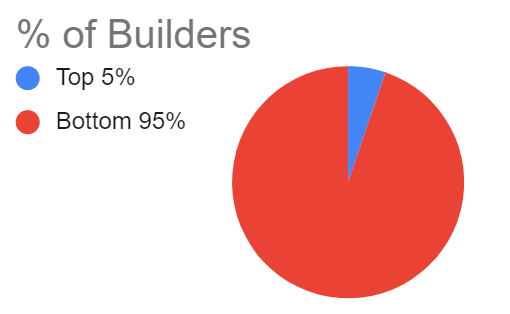
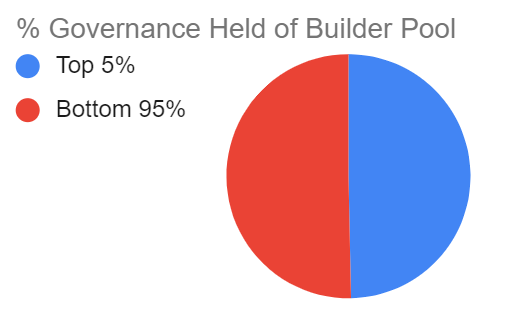
One final diagram of the governance breakdown of the Builder’s Pool (up to 25% of the overall TEC governance pool, depending on amount raised), which for me iterates the importance for a reasonable IH distribution adjustment, in order to prevent the majority of governance of the builders pool going to a very small group of <20 people out of a community of more than 400.
My goal throughout this process has been to answer specific questions that the community has. Working with @ygg_anderson and a few other people has helped me see the importance of also building tools (dashboards, etc.) so the community members can answer their own questions. Those are skills I will work to build in the future.
Here is my video on calculating some quantitative metrics for decentralization/distribution of Impact Hours compared to some other projects:
I am hoping to do one on the distribution by different categories later today. I hope this is informative and helpful.
Tomorrow, June 22nd at 7pm CET - 1pm EST, we’ll have a session to share the praise analysis results, chat about proposals and decision making and open space to listen to each other. 📢
📝 Call agenda
⭐ @ygg_anderson and the Labs team will present the praise analysis tools and findings, including this awesome Praise Analysis Dashboard!
⭐ We’ll go over the decision making process and share the problem set.
⭐ Everyone who wants to share their opinion on possible solutions will have 1.5 min
⭐ If we have extra time, we’ll start hacking on proposals.
How will the decision making process work?
Similar to the MVV and params sessions on Tokenlog, so most of us are already familiar with it. Here is a step-by-step. 🙂
Click “connect” on the top right corner, make sure to be logged in your Trusted Seed address
Pick your favorite proposals and distribute your votes! Tokenlog uses Quadratic Voting.
How is the winner chosen?
If a proposal has more votes than all the other proposals combined it is the clear winner. Otherwise, the top 3 to 4 submissions will have a runoff voting round and the one with more votes will win. Because of the potential for votes to be split amongst forked proposals that are similar, the Community Stewards will choose the top submissions for the runoff in an open call on the following Tuesday, June 29th at 7pm CET.
What if there is a polarized scenario, where 2 different proposals have an evenly split majority of votes in the run-off?
(By evenly split, we consider a difference of less than 10 votes between first and second place.)
In this case, the top 2 authors will be invited to a hack session to merge their proposals together and commit to a collaborative result.
Jeff! What you are doing is super brave and it’s important to stand for our beliefs, voice our concerns and suggest ways to improve. I’m sorry that you have felt disheartened and misunderstood, so I want to thank you for opening this discussion and for all the contribution you have done to the TE ecosystem, with the same strong ethics and skill.
This kind of processes are the ones that test our capacity to integrate feedback and improve our initial ideas. We are passing from fix to adaptive, in order to be short term responsive and long term strategic by proposing innovative solutions to our problems.
Here are the notes from today’s call. Thanks SO much to everyone who joined, special thanks to Ygg, Mohammed and Octopus for all the data analysis and dashboards!
I feel like I barely do anything in this community but try to bring awareness to personal development, interpersonal relationships and organizational development; but I have a lot of praise and impact hours.
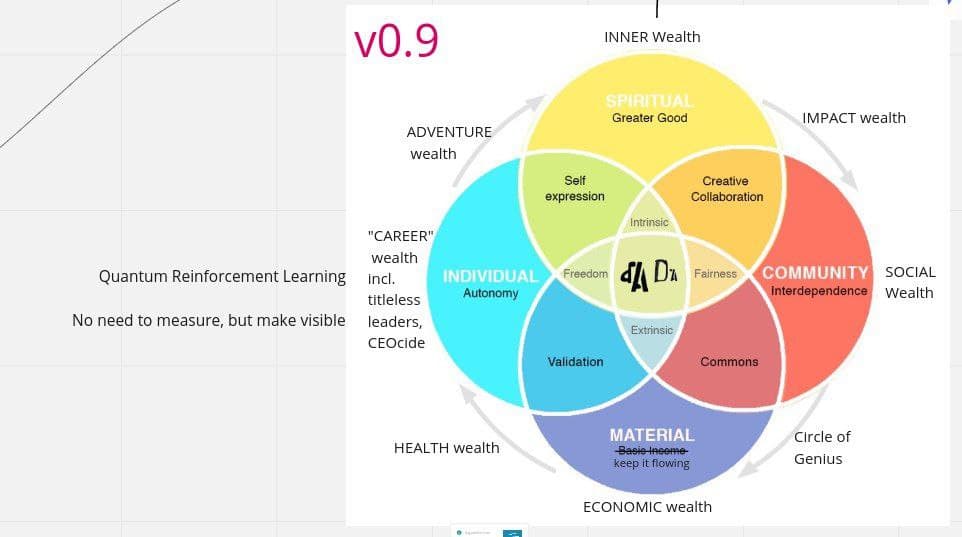
It’s flattering, but not granular. I like Sebnem’s Dada group’s Ikigai on this:
Which recognizes the aspects of the flow of feeling and praise for a specific set of needs being met, rather than a flatland idea of “praise” by itself.
Also, it seems to me that it’s not particularly important that “praise” in and of itself is not required to be all that fungible. Why can we not create a system whereby I, as a part of my own profile, be seen as someone who is “grateful” in one of the 8 forms of wealth: Sharma: The 8 Forms of Wealth | SUCCESS to some people?
Rather than “assign praise TO people”, we would ALLOW people to assign gratitude to themselves FOR a specific kind of wealth they have been given BY a certain person.
In this way, we handle the ACTUAL ownership of the gratitude where it belongs, and then you can see how someone’s relationship was shaped by their interactions, creating a map of their interaction and positive expressions toward others.
I find myself barely engaged in the praise system, as it does not speak about the only person I really care about- myself. That might sound horribly narcissistic, but what I’m saying is that changing how one represents one’s GRATITUDE is far better than representing it through praise, in my view.
We could still perhaps sum up ALL praise if we decided to do so, but I am continuously disappointed by the lack of actual humanity that the singular praise system flatland implies. I want to express my full self. Praise also has a kind of “flattery” feeling to it that irks me. I want to simply REVEAL MY GRATITUDE without having to SAY IT to them directly all the time.
Moreover, I wish that I could express my gratitude in terms of what ACTUAL impact a person has had upon the group itself- not just how I express gratitude in a personal way but also toward how I witness their impact upon the group.
For this, I’d want to use terms and representations that make sense to ME, regardless of the larger group’s decisions.
Also, “showing up” does create a certain kind of understanding of their participation in a group, but not in a granular manner. I often just audit some meetings and end up with praise for something I didn’t contribute to.
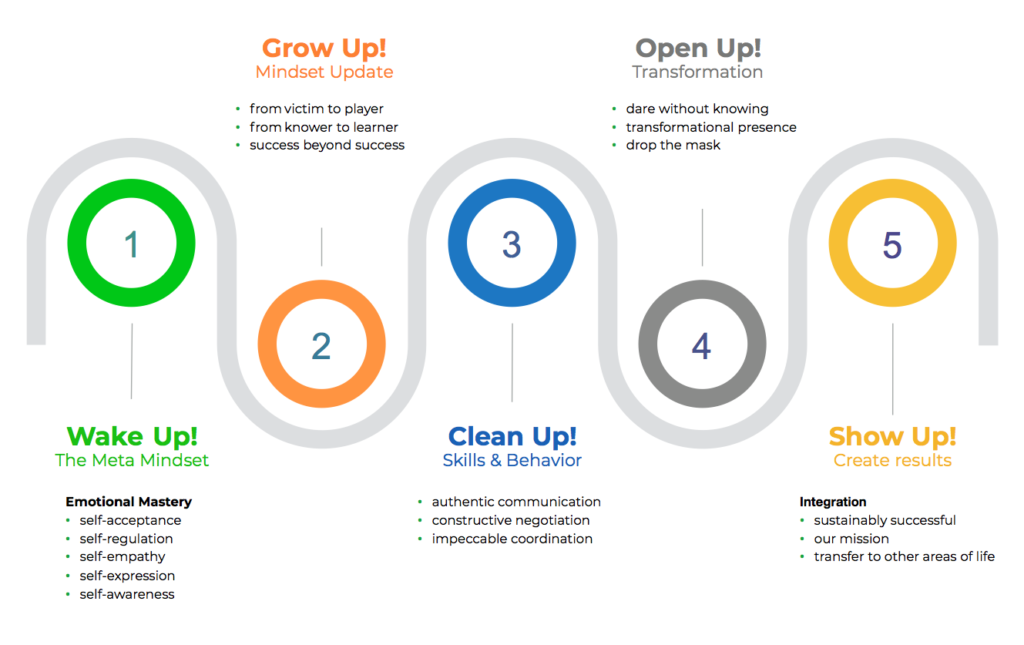
Why? Perhaps this praise I receive is a way to say “I showed up” and I get that, but I cannot see HOW a person is behaving without seeing also that not ONLY did they “show up” but also communicated authentically, or coordinated well (like Livi and Jess and Griff do, for example) which would be in “clean up” mode.
I myself am not that great at the “grow up” TECHNICAL part of the crypto space, as it’s a bit dense for me and I lack the time to penetrate into the depths of how it all works; even I display the “grow up” portion in other ways and areas. By lacking these things, we cannot properly engage with our community, quantitatively, since we are ‘flattening’ everything into mere praise.
We can see that our participation in a group setting would be greatly impacted by how one chooses to “show up” in a social setting. Maybe a person doesn’t talk much but when they do they are clearly communicating authentically, and I would want to recognize this, even during the meeting.
In short, I want praise to be a lot more granular and organized on people, not fungibility, or ease of programming or because we’re SO USED TO using oversimplifications of value like fiat currency to represent our gratitude.
In NVC, Marshall Rosenberg says that all we’re ever doing is saying “please” or “thank you”. I just want to be given tools to do this, and to reveal myself as transparently myself in a group like this, where I feel safe to express such things.
So, not having a way to assess or determine someone’s needs is also lacking here in the praise setup. Maybe a person doesn’t participate because they have a higher need for safety than others. Or they show up but never talk because of this. Or find it important to “be there” in meetings but their participation is expressed in other ways. Without other granular tools to assess and quantify these things, it will be harder to engage authentically.
After seeking advice process with @liviade, I propose we extend the proposal submission deadline to Tuesday, June 29 1pm EST / 7pm CET, begin voting on Tuesday June 29 at that time, and extend the voting deadline for the first round to the following Tuesday, July 5 (at the time of the beginning of Soft Gov. as normal).
Due to current workloads, myself and a few others from the community would like to participate, but are unable to submit proposals by tomorrow.
Extending would allow for 1) more quality proposals 2) time to communicate about the proposal submission and voting.
We gave a lot of time to MVV and other votes, and this vote is equally as important - if not more. I know we have a pressure and want to hatch, but a few days extension will not make too much of a difference (would actually allow more time for Communications) and would give more adequate time to this process. Thank you and I look forward to developing proposals this weekend.
@durgadas Thank you for that insightful contribution. I agree with you that I think the Praise system has perhaps confounded [still potential] monetary compensation with gratitude, and the two do not seem to mix well unfortunately.
Fantastic comment: “changing how one represents one’s GRATITUDE is far better than representing it through praise, in my view.”
Perhaps the Praise system needs to lose its [potential] monetary value. It appears to be destructive and counterproductive to the concept of praise (small “p” - common noun). I nearly wanted to say it is “counterproductive to its actual intention,” but that doesn’t seem accurate, as I think the Praise system was created as a way to compensate folks who were otherwise not being compensated.
Praise-gate (as @natesuits once called it 😛 ) shows, among other things, the complexity and essentially impossibility of mixing gratitude with money --or rather perhaps, of “accurately” showing gratitude through money…
@JessicaZartler, I want to get my head around the impact to timelines from the proposed extension.
Here is what we are currently aiming for: Jun 29: Primaries close June 29: Create runoff proposals Jun 29 - July 1: Runoff Week of July 5: Hatch
Admittedly, it’s the fastest option. The runoff proposals would be made quickly and the runoff would happen quickly, though there will be fewer, and more distinct, proposals on the table so deliberation should not need to take so long. But it does all happen during the week.
Would the timeline you are proposing look like this: July 6: Primaries close July 7: Create runoff proposals July 7-13: Runoff July 16/17/18: Hatch
When I look at this timeline, I question whether there would be any real significant benefit from drawing it out this long.
An extended version that was discussed in case the target was unachievable looks like this: July 1: Primaries close July 2: Create runoff proposals July 2-6: Runoff July 9/10/11: Hatch
It allows some more time for the initial proposals to be voted on and for the runoff to happen over the weekend instead of mid-week. I’d offer this as an extended alternative if we want one.
Gentle reminder to submit your IH intervention proposal if you have one in mind! We’ll have the results of the primaries on Thursday during the community call, and it would be great to have at least two days fully for voting, when all the proposals are there.
Great points and important considerations, thanks for the post @durgadas! 🙏
I am about a quarter way through Punished By Rewards, and what I have taken away thus far on Alfie’s view on incentives is that:
A. they work (as evidenced through the study of token economies), but
B. they give a lot of power to the people setting the incentives, which can be dangerous due to the potential for manipulation of others.
Thus far, the main question for me has boiled down to: Is there a way we can set incentives for ourselves to encourage socially beneficial behavior, both for ourselves and those who choose to operate in these new paradigms with us?
I believe we are on the cusp of new coordination tools that can tip the default behavior from defect-defect to cooperate-cooperate for a wide range of public goods - but Alfie speaks about incentives almost exclusively from an “imposed from the outside” perspective, which I find a little insufficient in terms of how these considerations can factor into how we are using them - as internalized, community-directed incentive mechanisms for mutual benefit.
I appreciate your philosophical insights into the use of these kinds of reward tracking systems, and I agree that perhaps gratitude should factor into the ways that we recognize and appreciate what we & others bring to the table. I also strongly resonate with your statement that connecting praise to money was perhaps an overreach of the praise system. This thinking helped to inspired the proposal I submitted yesterday.
On initial calculation, 96-98% of all IH holders are better off under this more equitable distribution (compared with ‘no intervention’), including most of the core community of TEC stewards. It seems strange to me that the inflated IH rewards accrued by less than a dozen people should be held as more important than a broader, more equitable distribution of IH for 97% of participants.
I invite readers to vote for more equitable distribution of Impact Hours for work done in the TEC.
The primaries were delayed 24h, so they will close tomorrow, June 2nd at 8:30pm CET. Following that we’ll have a session to prepare the runoff votes and continue with the following dates: July 2: Primaries close July 2: Create runoff proposals July 2-6: Runoff July 9/10/11: Hatch
Hello everyone. I got curious and took a look at the json raw voting data on the tokenlog page. Having seen these results it feels that this data can help inform our voting designs and the current discussion about IH distribution.
It has been requested to post the text here, so here it is:
Disclaimer
No system is perfect.
We are at the vanguard of self governance.
We learn with every experiement and continuously improve our system designs.
What this is about
Using the json raw voting data on tokenlong (view stats), I was curious to see how quadratic voting would play out given our specific Voting Power algorithm that accounts for IHT and CSTK tokens.
I am sharing what I found because we are counting on quadratic voting as a type of mitigation against a few whales determining the outcome of a vote. It does not appear that this data backs up that assumption. That is my initial impression. There may be arguments that we want a few whales to be able to do so. That they have earned the right. I may have made a mistake in my calculations. I leave these possibilities open to the community to determime.
I anticipate that there will be people with very strong opinions about this result. And there is a real risk that discussions about this will necessitate extending the target date for the Hatch. Or worse, result in any negative sentiment. We are a kind, compassionate, respectful, introspectful and data-driven community and I hope that is enough to avoid the latter.
Here is the xls. This file does contain the unique addresses parsed from the json but for the sake of simplicity I have assigned each unique address a simple name: Voter A, B, C, etc.
Others are welcome to use this file for deeper analysis that my cursory one.
Voting Power
To the best of my knowledge, this is how Voting Power has been assigned for our use of Tokenlog. I texted directly with Wesley who was generous with his time and explained it to me patiently. If I have made a mistake in my understanding, I welcome the correcion. My goal is to have a shared understanding so we can improve.
Multiplier = the ratio beteen the two token supplies.
Simply put: The % held of the IHT supply is multiplied by the multiplier and then the CSTK score is added that figure.
The examples below show an approximate amount of IHT and CSTK suppy. They are not exact but not far off. The examples were chosen to showcase two opposite-ended cases:
High IHT, low CSTK score
Low IHT, high CSTK score
Examples:
500 IHT (5% of 10,000 supply)
600 CSTK (0.06% of 1,000,000 supply)
Multiplier, the ratio between the two supplies, is x100.
(500x100) + 600 = 50,600 VP
100 IHT (5% of 10,000 supply)
20,000 CSTK (2% of 1,000,000 supply)
Multiplier is still x 100
(100x100) + 20,000 = 30,000 VP
I wanted to share a discussion we’re having on Discord to make it more visible.
My understanding of Quadratic Voting is that the “amount” of votes should be the square root of the “cost” of voting power utilized. In the raw JSON data, this is mostly true, but not uniformly. There are places where the amount is not equal to the square root of cost, sometimes significantly so. This is not a simple rounding issue.
Great analysis @Tamara, it is important to understand the underlying dynamics of the signaling tools we use for decision making, and their implications on the output. Thanks for pulling this together! An important step in our collective learning process.
Good catch @octopus - not sure why this might be, but I did notice something funny in the voting process that could be a possible culprit. Since I didn’t want to vote all in one block, but rather spread votes across multiple proposals, I submitted several subsequent votes for the same proposal, and noticed some funny math when adding tokens later (e.g. 1 of my votes cost 257 tokens, which seemed strange to me.) Perhaps there are some edge cases in the quadratic calculation when casting subsequent votes?
I was mistaken previously; when cost ≠ (amount)^2, it is always the case that cost > (amount)^2.
It does seem that this happens when the same tokenAdress votes more than once for the same number. I can’t figure out any more than that at the moment.
Thanks very much Tamara for posting the data break-down. It gives a fast and accurate idea of what the community wants. Sometimes the emotions can run hot but TEC seems to be doing a professional and considerate examination. Thank you for the time and effort everyone is putting in. This is mostly beyond me as a new small fishy but it matters still. I was really affected by the idea that ‘no system is beyond questioning.’ It is some sort of powerful reminder. A reminder to keep growing and keep evolving. And thanks Jeff for writing the radical piece about re-thinking the praise system. Thanks everyone for doing the hard work. Sending supportive vibrations your way TEC.
Thank you for this information. It helped me figure out the issue: when a Token Address votes for the same Proposal more than once, the subsequent contributions are sometimes playing catch-up.
For instance, in the spreadsheet, look at rows 1 and 3, where address 0xaa78…98737 is voting for Proposal 1 in two separate transactions. The first transaction has a perfect square root: 22^2 = 484. The next time this address votes for Proposal 1, the cost is 99732 and the amount is 294, which looks like an undercount. However, sqrt(99732 + 484) = 22 + 294, i.e. this new amount is what is needed to make the total cumulative amount for this address to be equal to the square root of the total cost.
Updated the xls with the final results of the first round of votes. The runoff votes are now happening, go here and vote! The vote ends Tuesday, July 6, at 8pm CET.
Of interest to me here is that:
If not for the 24 hour extension of the vote (noted by the black line between voter DD and EE), the decision would have been made by, essentially, 4 of the 30 voters.
The additional 7 voters in that 24 hour period applied 71% of their quadratic votes (723 of 1023) to proposal 2, which swung the vote in that direction.
What lessons are there to be learned here for the upcoming runoff vote and for voting process design in general?
Griff added a tab to do show a recombintion of percentage of voting power applied.
So if:
Voter B applied 60% of her voting power to proposal 3 and
Voter H applied 40% of her voting power to proposal 3
Then:
Proposal 3 would have a combined 100% of a voter-unit.
This is super interesting! It’s not exactly 1-person, 1-vote but it does ingeniously try to simulate that idea. Maybe it’s more like 1-recombined-person, 1-vote .
Yesterday Jeff, Griff, Tamara, Jess, Juanka, Zeptimus and myself had a session to prepare the runoff proposals and its details. The top 4 went live and considering the community feedback, we decided to extend the closing of the votes to Thursday, July 8th
No more proposals will be submitted in this round and we’ll be hosting debates this week to discuss them. Feel free to host a debate as well by adding it to the TE calendar!
Thanks to everyone who has been involved in this conversation. Please help us promote this voting round!
Thanks for your continued analysis @Tamara! I think this is a fantastic learning experience for the TEC community to get a tangible feel for various kinds of voting: 1P1V, 1T1V, quadratic voting, and how all of these tools give us different signals to interpret outcomes in the context of the defined decision space.
I wanted to point out another vote weighting tool called Democonomy (introduced by the Saga project), in case it might be useful here (or in the future) as well. It dynamically weights decision making between whales and minnows according to the gini coefficient of the ecosystem. They also produced a fantastic infographic that walks you through how this plays out in several scenarios.
The infographic is a great way to discuss and demonstrate these various voting optimization tools as well, perhaps something we can emulate! Learnings on every side. 😄
The data we have here is empirical. It accurately shows what actually did happen based on our employment of quadratic voting.
The data shows how many unique addresses participated, how much voting power they used and where they applied that voting power. That’s all.
Here is what stood out about the results to me:
Before an emergency 24 hour extension was granted:
The top 4 out of 30 voters (13%) accounted for 50% of the entire voting power used.
After the 24 hour extension:
The top 5 out of 37 voters (14%) accounted for 50% of the entire voting power used.
Are these the results we expected?
Is this what we want?
Before the 24 hour extension:
After the 24 hour extension:
Choosing the runoff proposals
In the end, the final runoff proposals were determined based on Griff’s calculations of applied voting power. That is the simulation of one-person one-vote in one of the xls tabs.
Using that method there is only one change in rank: Jeff’s praisemageddon comes in second, ahead of Sem’s no-intervention. The rest appear to be ranked the same order as the quadratic voting results.
The Saga project closed it’s doors earlier this year. I will ask them if they have any data on how this voting optimization tool worked for them.
In terms of voting optimizations (quadratic vs 1P1V vs democonomy), I wanted to share some feedback on the IH process so far from @mzargham: the power law distribution of IH is exponential, not polynomial, so maybe you need LOG voting not square root. I wonder if this is an addition to Tokenlog that could prove useful in this and/or future votes with exponential (i.e. highly inequitable) token distributions.
In order to help participants remain neutral in the discussion and realign this debate with Rawl’s Veil of Ignorance, he also recommended a fantastic mechanism to help large holders separate the outcomes of this discussion from its impact on their personal holdings: what if we decided that there was going to be a lottery and everyone was going to have their IH swapped (or averaged) with the person they drew at random? I think this is a fantastic thought experiment that may sway some whales from voting solely for outcomes that preserve their outlandish amounts of IH.
All in all, I think this is a fantastic learning experience for the whole TEC, to have a example data set to run through these various optimization functions and gauge what we feel is fair and accurate, in line with the needs and values of the community. Much better than blindly “trusting the algorithm” that what comes out is truth. Do we want to allow a handful of whales to determine the direction of the TEC, now and moving forward? Making use of a future collective intelligence toolkit demands that we be critical and thorough with our analysis and use of these tools. Thanks again for all your hard work in pulling and analyzing this data @Tamara!
Respectfully, I respect clarification on this. Power-law distributions and exponential distributions are completely different things. What aspect of this distribution is leading to the claim of “exponential”?
Power-law distributions have a roughly linear relationship between log(x) vs. log(P(x)), where exponential distributions have roughly linear relationships between log(P(x)). If this were an exponential distribution, we would expect roughly the same % increase along similar scales. Do we see that?
It’s a technical but important question to iron out, since we’ve been working on the assumption of this being a Pareto power law distribution. I’m open to being convinced that this is better fit by an exponential distribution, but it’s a strong claim that needs evidence. It would be unusual to see human work or resources following an exponential distribution, and would indicate that Impact Hour distribution was really abnormal in some interesting way.
Remember, the IH’s only represent 10-25% of the TEC Hatch tokens (most likely around 20%), and the rest of the Hatch Tokens will be held by members of the Trusted Seed that send wxDai into the Hatch. Then both groups will be diluted by the Minting of tokens from the Augmented Bonding Curve.
Quadratic voting specifically addresses the issues around voting power distribution, only looking at voting power is ignoring the quadratic voting factor and I would argue creates irrelevant statistics.
We count votes, not voting power, so we should look at votes when analyzing the data.
I didn’t make the charts, but i added the vote math to the spread sheet and it took 9 voters before the extension and 10 voters after to have a majority.
The top 9 out of 30 voters (30%) accounted for 50% of the entire votes counted.
After the 24 hour extension:
The top 10 out of 37 voters (27%) accounted for 50% of the entire votes counted.
These are pretty good results, skin in the game should be included in the dynamics. IMO the comparison between voting power and the votes that actually count shows why we chose to use tokenlog and quadratic voting.
“Is voting power relevant?” is a good question to challenge our most basic assumptions. My understanding is the correlation with votes-that-can-be-cast makes it relevant in this discussion but agree we should also look at the actual votes cast.
I come to a diff result for the first part (see below) but the same for the second.
I believe the following is a true. Is there a mistake I don’t see? Based on the tokenlog data of the primary voting period:
it would require 10 of 37 voters, 27% of voters, alone to determine the winner.
If all other 27 voters combined, 73% of voters, voted for a single but different option, they would not have enough votes to pass it.
Before the 24h extension: 8 out of 30 voters (27%) cast 50% of the total votes.
After the 24h extension: 10 out of 37 voters (27%) cast 50% of the total votes.
I have created an intervention proposal that address all of the concerns raised by the community. It can be considered an implementation reference of 🔥 PRAISEMAGEDDON 🔥
Right now, no proposal has a majority of votes. not even close… The top voted proposal has ~40%, and the results have flipped at some point the Praisemageddon proposal was in the lead in the last few hours, tho the No Aliens proposal has come back and taken a large-ish lead.
This has been a horrible horrible experience for our community. I regret that we even debated this at all. I really do. The repercussions of this debate are going to hurt no matter what the results are.
We have an extremely polarized community right now. This shit is like democrats vs republicans on twitter, it’s gross. 🤮
That said, we have to accept that we are where we are and think about what is best for the Commons.
The rules set forth for this vote say what we should do in the case of a polarized vote:
What if there is a polarized scenario, where 2 different proposals have an evenly split majority of votes in the run-off?
(By evenly split, we consider a difference of less than 10 votes between first and second place.)
In this case, the top 2 authors will be invited to a hack session to merge their proposals together and commit to a collaborative result.
—End Quote—
I think it was a mistake to define this so specifically as 10 votes… and that the spirit of the idea is that we should accept a polarized result (Praise Juanka for the forethought here).
I would like to propose that we follow the spirit of these rules and that Jeff and I hack out a final solution that is a combination of both proposals. We have a lot of different opinions on a lot of things, but above everything else, we love each other and this community and will find a solution that we can be proud of.
What I would propose to start is that ~50% impact hours from 🔥 is counted as people’s IH and ~50% impact hours from 🚫👽 s counted as people’s IH and the 2 amounts get added together.
The 50% wouldn’t be 50% but would be the % of votes that each proposal got.
This allows everyone to win a little bit, and everyone’s votes to be counted which is just the best that we can do right now. Instead of a clearly defined set of winners and losers, we can have all the voters for these 2 proposals represented in the final outcome.
Honestly, this whole time I have been watching this as a train wreck waiting to happen, i never saw a way to push the car off the track to avoid the destruction ahead…
Amazingly, I think that with a proposal like this we can actually “Split the baby in half” and it will work out. (google that phrase if you don’t know what i’m talking about)
I have had a lot of anxiety about this, and when Livia brainstormed with me and this idea popped out, it was the first time in weeks that I felt hope around this situation. That we could actually have a solution that doesn’t completely just disregard a large swath of our community.
I’m not happy about an intervention at all, I never thought it was a good idea, we should have clearly laid out the rules in advance if we wanted to do that and then stuck with them IMO it’s too late to change the rules and decide to take from some to give to others. But that is not everyone’s opinion and I really love that we have a community of diverse opinions.
Looking forward, COMPROMISE is a value that will hold us together better than accepting the vile, false dichotomies of democrat vs republican, socialist vs libertarian, Good vs bad, right vs wrong.
There is no “good” here, there is no “right” here. There is only best…
Compromise is something I think we as a community can be proud of, and it is at the very least in the spirit of the rules as set forth for this process, if not explicitly defined as the solution for a polarized outcome.
I think it was a mistake to define this so specifically as 10 votes… and that the spirit of the idea is that we should accept a polarized result (Praise Juanka for the forethought here).
Agree on this.
For completion, here is how the final result breaks down.
I want to address three separate things in one post
First, I wish I had waited to reply to the post by @JeffEmmett about the ideas of log voting and randomization. In rereading my response, I don’t think it fits the spirit of this community, and comes across as much more combative than intended. Precision over terminology can come later in the process, if it even matters at all – we can discuss the ideas on their merits in a way that is accessible to all without getting bogged down in technicalities. Let’s avoid the Green Lumber Fallacy
Second, I want to commend both @JeffEmmett and @Griff for their conciliatory energy in the debate earlier this week. This community is really something special, and I think that the way this discussion proceeded is actually a net positive for its growth. I want to thank everyone who met with me and helped me grow as a data analyst through this process.
Finally, on quadratic voting. It seems we are considering various alternatives, and I wanted to point to the pairwise modifications used by GitCoin. I believe the version currently being used by TokenLog is just sum(sqrt(x)) (where x is a list of the quantities of votes for a proposal). The GitCoin version is square(sum(sqrt(x))) - sum(x) – this subtracts off the original voting power, so if only one person votes for a proposal, that proposal receives 0 votes. There is a blog post by Vitalik Buterin with a nice geometric illustration: Pairwise coordination subsidies: a new quadratic funding design - Economics - Ethereum Research
The article also proposes a “pairwise coordination subsidy” which is a second potential modification – this essentially punishes the formation of coalitions that only vote for one issue. These ideas are already established in a related community, and they might be worth throwing in the “Voting Ideas” hat.
I love that the last intervention call became so emotional. I love being part of a community that has the courage to approach these difficult questions. Let’s use this opportunity as a learning and growing opportunity! Thank you all! ❤️❤️❤️
I didn’t take the chance to voice my thoughts at the end of the call. So, here are my 5 cents.
A lot of focus within the DAO space has been on voting. But the way votes are constructed often leads to polarization. And the more at stake, the greater the polarization. It is tempting, like we have done, to do voting rounds where in the final round it stands (mostly) between two finalists. Choose A or B, democrat or republican. First primaries, then presidential election. Polarization is inevitable in this scenario.
How can we avoid that? Maybe the suggestion by @Griff is the way to go from now on? From now on all votes end in compromise.
We want the final decision to represent the opinion of, lets say, 75% of the community. Maybe the top five proposals make up 75% of the vote. Then those five proposal authors have to sit down and come up with a final decision where the intentions of each proposal is weighted against the others.
How does that process look? Probably not look like a hard negotiation but more like a “warm data lab”, as described by Nora Bateson. That for one means the process would need to be facilitated by some outside neutral person.
Imagine a presidential election where the two top most candidates would together get the task of coming up with a third person to step in as president. Compromise!
Would it be interesting to explore this process, formalize it and describe it?
ps. Another way would have been not do this kind of voting at all. I think it can be valuable to explore conviction voting as a tool for signalling and deciding outcomes for these kinds of issues as well. How do we move from a mindset of coming up with better voting tools to one of coming up with better proposals?
The Impact Hour analysis and voting process are over and here is a summary of what happened and how we are moving forward:
The TEC has chosen to use the Trusted Seed Swiss Association as its legal strategy to offer a shield to Hatch participants who will be bootstrapping the TEC’s economy. Contributors who have received Impact Hours through praise but haven’t yet activated its membership won’t receive IH tokens.
During the last 2 months, all the praise dished in the TEC were analyzed. We gathered the issues raised into a problem set that served as the template for IH intervention proposals on Tokenlog.
Does this proposal address that some categories may be under rewarded and others over rewarded?
Does this proposal address the fact that paid contributors have had a 50-85% reduction to their total number of impact hours?
Does this proposal address that foundational members of the Token Engineering Community may lack recognition for their less visible work?
Does this proposal address the distribution of impact hours in relation to equality metrics such as the Gini Coefficient?
9 proposals were submitted and the 4 top voted ones made it to the runoff.
No Abnormal Intervention addressed problems 2 and 3. #2 - It suggested an infinite vesting for paid contributors, so they would still have a financial deduction but not a governance deduction for most of their IH. #3 - Proposed a Praise party for Token Engineers to ensure they were well rewarded.
Praisemagedon addressed the 4 problems by suggesting reshaping the distribution, dividing contributors into activity buckets of high, medium, low and longtail. It also suggested an adjustment for paid contributors.
The community reaction to these 2 proposals was very polarized: No Abnormal Intervention had 2590 votes and Praisemagedon had 2389 votes while 3rd and 4th places had 1292 votes combined.
60 unique addresses participated in the full voting cycle including the primaries and a total of 12920 votes were cast.
A scenario that would make half of the community unsatisfied if either of the top proposals won didn’t sound right. We are a value aligned community that has been working incredibly well together for the past year. This was the first polarized situation we have faced, and the first opportunity to choose compromise.
For context, the winning Hatch Params proposal #83 has set a percentage of the total token supply to be allocated to builders. 25% at the min goal, 20% at target goal and 10% at the max goal. The total number of Impact Hours being distributed is 9731.413.
Proportionally to the number of votes of the runoff, No Abnormal Intervention will have an impact over 52% of the IH and Praisemagedon over 48% of the IH. So if we reach the max goal for example, 52% of those 10% will be impacted by No Abnormal Intervention, and 48% of those 10% will be impacted by Praisemagedon.
How is each proposal being implemented?
👽 No Abnormal intervention:
It maintains the original IH distribution to 52% of the total IH.
The last praise quantification had a larger distribution than normal with a bonus for Token Engineers who were praised in the “TE praise party”
A proposal to implement infinite vesting to paid contributors might be submitted to the Commons after the upgrade.
An audit was made to adjust paid contributors’ rates and fix errors from previous quantifications, maintaining the policies used in the process so far.
🔥 Praisemagedon:
Contributors were divided into 4 buckets based on their activity.
The buckets will correspond to Praisemagedon’s 48% distribution.
We have 29 contributors in the high bucket that will receive 50% of the distribution, 46 contributors in the mid bucket that will receive 30%, 115 contributors in the low bucket that will receive 15% and 193 contributors in the longtail bucket that will get 5% of the distribution.
To prevent a sharp drop between one bucket and another and aim for a gradually round-out distribution, a curve will be applied according to the total IH each contributor would receive if adjustments haven’t happened. Eg.: 2 people are in the mid bucket, one with many IH, other with less IH. The one with more IH will be on the top of the mid bucket, while the one with less will be in the bottom, closer to the low bucket.
After the bucket distribution is ready, another augmentation will be applied where paid contributors will get deductions according to how many times they received compensation.
This post will continue to be updated in the next couple of days when everything is ready and the lists with the IH results can be shared in their last version for the Hatch.
Thanks to everyone who is participating in this process ❤️
I have been predicting this since the inception of the praise system. It “works” but in a way that replicates many of the problems with the centralized banking system. Not ALL of them, but enough to make it distasteful in some ways.
Quantifying qualitative contribution is always dirty… UBI and a culture of giving (burning man style) are better solutions than this… they just avoid the quantification all together and just reward you for being there.
But I think here we have to remember what the problem is we are trying to solve and evolve to better solve it:
Problem: How do we we reward TEC contributors with sweat equity in the TEC.
Pre-Hatch Solution: Quantify Praise to catch the qualitative work and the quantitative work
Next evolution of the solution seems to be: Quantify Praise to catch the qualitative work and use Sourcecred to distribute value to the quantifiable work.
To reward the qualitative value people are producing, we must acknowlege it (praise does this pretty well!) and then we have to measure it… which is the really hard part.
Update: The vote to restore 75% of governance rights to those who had had theirs deducted will be voted on from Sept 24 -27. There will be a snapshot vote and this is the forum post with the latest information: 75% Governance Giveback - #17 by Juankbell